SIGNALTUBE GUIDE · UPDATED NOVEMBER 3, 2026
Best Hacker News Talks: Top 50 HN Video Picks
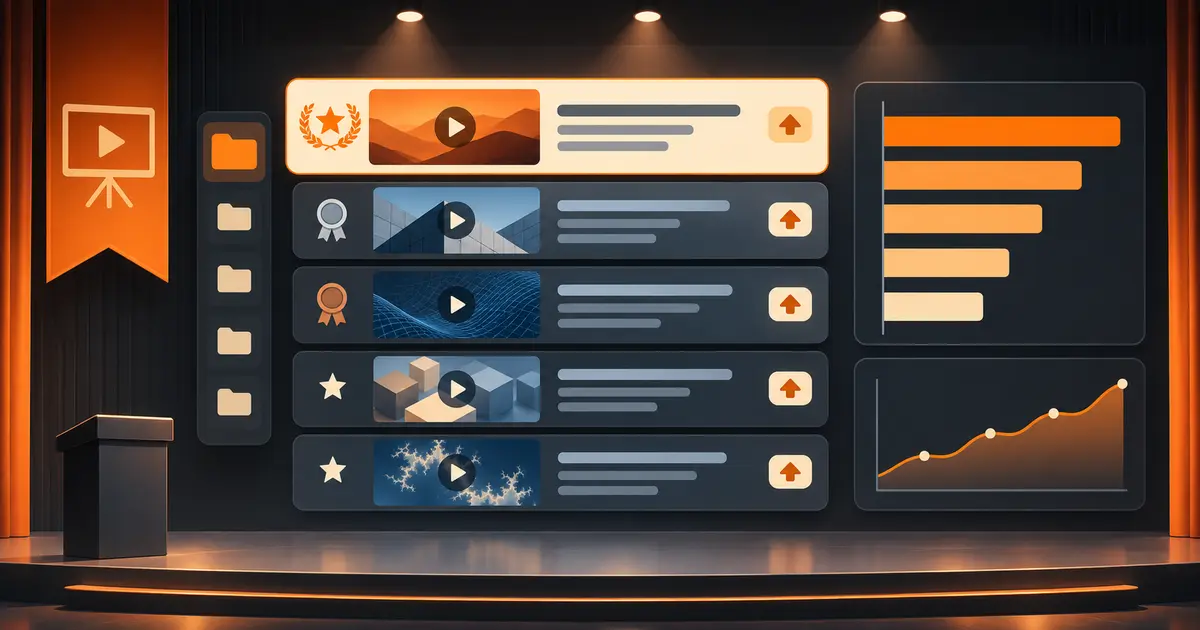
The best Hacker News talks in this guide are the 50 catalog videos with the highest distinct-recommender counts in the current SignalTube dataset. Each entry links to a detail page where you can inspect its Hacker News context and source comments.
This is a discovery shortlist, not an objective measure of educational quality. A repeated recommendation can help surface a talk, but topic fit, speaker, duration, and the original discussion still matter. The rankings use the HackerTube export’s HN fields and do not use YouTube views or watch time.
Top 50 talks by distinct HN recommenders
- Indistinguishable From Magic: Manufacturing Modern… — 19 HN recommenders.
- Ruby Conf 12 - Y… — 17 HN recommenders.
- The Soul of Erlang and… — 16 HN recommenders.
- What the heck is the… — 16 HN recommenders.
- The Tragedy of systemd — 16 HN recommenders.
- How Python was Shaped by… — 15 HN recommenders.
- RailsConf 2014 - All the… — 15 HN recommenders.
- A Better Default Colormap for… — 15 HN recommenders.
- Rich Harris - Rethinking reactivity — 15 HN recommenders.
- "Simple Made Easy" - Rich… — 14 HN recommenders.
- Maybe Not - Rich Hickey — 14 HN recommenders.
- Preventing the Collapse of Civilization… — 14 HN recommenders.
- 8 Bit & '8 Bitish'… — 13 HN recommenders.
- Designing the Ideal Bootstrapped Business… — 13 HN recommenders.
- Steve Jobs Stanford Commencement Speech… — 13 HN recommenders.
- Lexical Scanning in Go -… — 13 HN recommenders.
- The Real Story Behind Wayland… — 13 HN recommenders.
- CppCon 2016: Jason Turner “Rich… — 13 HN recommenders.
- Reverse emulating the NES to… — 12 HN recommenders.
- Quantum Computing for Computer Scientists — 12 HN recommenders.
- Juice it or lose it… — 12 HN recommenders.
- What Bodies Think About: Bioelectric… — 12 HN recommenders.
- "Testing Distributed Systems w/ Deterministic… — 12 HN recommenders.
- Bret Victor - Inventing on… — 12 HN recommenders.
- How To Design A Good… — 12 HN recommenders.
- Bret Victor The Future of… — 12 HN recommenders.
- Why Isn't Functional Programming the… — 12 HN recommenders.
- Treating the Farm as an… — 12 HN recommenders.
- Finding the Missing Memristor -… — 12 HN recommenders.
- "Performance Matters" by Emery Berger — 12 HN recommenders.
- Antonin Scalia - On American… — 12 HN recommenders.
- AWS re:Invent 2018: Amazon DynamoDB… — 12 HN recommenders.
- Hammock Driven Development - Rich… — 12 HN recommenders.
- USENIX ATC '21/OSDI '21 Joint… — 12 HN recommenders.
- Using Python to Code by… — 12 HN recommenders.
- Mike Monteiro: F*ck You, Pay… — 12 HN recommenders.
- Dan Abramov - Live React:… — 12 HN recommenders.
- The Quantum Conspiracy: What Popularizers… — 11 HN recommenders.
- William Byrd on "The Most… — 11 HN recommenders.
- 🚀 TDD, Where Did It… — 11 HN recommenders.
- Growing a Language, by Guy… — 11 HN recommenders.
- A Philosophy of Software Design… — 11 HN recommenders.
- The Thirty Million Line Problem — 11 HN recommenders.
- Breakthrough in Nuclear Fusion? -… — 11 HN recommenders.
- JavaScript: The Good Parts — 11 HN recommenders.
- Agile is Dead • Pragmatic… — 11 HN recommenders.
- DEF CON 25 - John… — 11 HN recommenders.
- Failing to Fail: The Spiderweb… — 11 HN recommenders.
- Casey Muratori – The Big… — 11 HN recommenders.
- The A.I. Dilemma - March… — 11 HN recommenders.
Best Hacker News talks: how the Top 50 are ranked
The list sorts eligible catalog videos by the number of distinct Hacker News recommenders, with the catalog score used to break ties. This offers a transparent way to find talks that multiple commenters singled out. It does not claim that the first result is the best talk for every person or that every mention was a positive recommendation.
The source distinguishes strong recommendations, ordinary recommendations, references, critical mentions, and jokes. The top-level list is an efficient starting point, but a video detail page provides more context: total mentions, the date span, topic labels, and links back to individual HN comments. Use those details when the raw rank alone does not explain why the talk appears.
What “best” means in this guide
“Best” here means most frequently recommended by distinct Hacker News commenters in the source snapshot. The phrase describes this page’s sorting rule, not a quality certification or a claim that the site reviewed every talk. Some recommendation comments may be old, some may refer to a specific technical question, and some discussion labels may be contextual rather than positive.
A list based on the same count can still be useful if its limits are explicit. It provides a community-shaped index for choosing what to inspect next. If two talks have similar counts, compare the years they were discussed, their topic tags, and the source threads. A focused topic page may be more useful than a global ranking when you already know what you want to learn.
Browse talks by subject and format
The wider catalog organizes videos into 150 topics and 16 areas. A “talk” label is only one format among lectures, courses, interviews, explainers, and documentaries. Topic tags let you narrow the selection to a subject such as programming languages, robotics, or visual mathematics. Topic membership overlaps, so the same talk can appear on multiple subject pages.
If you are choosing a long watch, verify runtime when a verified value is available. The original export does not provide duration for all entries, so missing runtime should remain unknown. Use the channel field as a starting point for attribution, but confirm speakers and dates on the video itself when that information is important to your decision.
How to read the list before you watch
Open a promising result and ask three questions. What topic does the catalog assign? What role did the Hacker News comments play? Do multiple commenters recommend it, or does the count include a large number of contextual references? The site shows aggregate stance labels and sample links, while the full discussion remains on Hacker News.
Then compare the talk’s level and format with your goal. A highly repeated advanced talk may not be a good introduction. A broad lecture may be valuable even with fewer recommenders if its topic is exactly what you need. The ranking reduces search friction; the final choice should still be based on the actual video and your background.
A practical research workflow
Use the global list to identify candidates, then switch to a topic page to compare related picks. Read the page’s independent summary for format, audience fit, and dataset counts. Open a source-comment link for the exact context before treating a mention as an endorsement. Finally, save the video to a local playlist if you want to return to it after finishing another talk.
For a programming-focused shortlist, compare the language-design and functional-programming topics or open the dedicated programming-talk guide. For a broad introduction to the archive, read the project background. These internal paths keep the research within one site while preserving source links on each video page.
Keep the ranking useful and current
A catalog ranking is tied to a particular dataset snapshot. If new Hacker News discussions are added, counts and order may change. If a YouTube video becomes unavailable, it should not remain in a public sitemap simply because it had a high historical recommendation count. A good archive keeps the snapshot date and availability state visible enough to interpret changes.
The SignalTube list is generated from an attributed public export and its current indexed video set. YouTube upload dates, durations, and views are separate fields and should not be inferred from HN history. Continue with the topic index, the dataset guide, or a featured video page to see how the list connects to the underlying catalog.
Frequently asked questions
How are the best Hacker News talks ranked?
The Top 50 are ordered by distinct Hacker News recommenders, with the catalog score breaking ties.
Does the list prove that a talk is objectively best?
No. It is a discovery list based on recommendation counts and does not certify quality or fit.
Are all entries programming talks?
No. The list spans many subjects; use topic pages to narrow by interest.